
Search Pulaski County Property Records
Land research in this corner of Kentucky works best as a chain. Pulaski County property records tie a single parcel to deeds, tax assessments, map IDs, court files, and municipal land-use paperwork. Each office keeps its own piece. Start from whatever you already know, whether that is an address, an owner name, or a map ID, and search Pulaski County property records by address or parcel from there. The county clerk, the PVA, the tax office, the map tools, and the courts each answer a different question. Match one parcel across all of them. That comparison, not any single source, gives a result you can trust. Tax rolls add context. Deeds settle ownership.
- Search the PVA by the address or owner, then copy the complete map ID and ownership wording.
- Use the owner and parcel clues in the Clerk's land-record system to locate the latest deed.
- Read the deed's legal description, book/page or instrument reference, parties, and any cited plat.
- Check assessment and tax sources, then use mapping only to add location context.
- Request a regular or certified copy from the custodian when the online source is blocked or incomplete.
Pulaski County Records Custodians
Three offices split the core work on Pulaski County property records. The Clerk records land instruments and issues copies. The PVA keeps the assessment roll and values. The Sheriff takes current tax payments. Delinquent certificates along with tax-sale records move into the Clerk's process after the statutory transfer. When ownership, assessed value, or payment status may have shifted, check all three.
Pulaski County PVA
100 North Main Street, Room 201
Somerset, KY 42501
606-679-1812
Pulaski County Sheriff Tax Office
P.O. Box 752
Somerset, KY 42501
606-676-9637
Pulaski County Records Since 1799
The Clerk's physical collection reaches back to about 1799. Its online land-record coverage starts around 1990. That gap matters. A search with no pre-1990 online hit has simply hit the limit of the web index. It is not the start of ownership. Older work shifts to deed books, plat books, tax lists, and probate files. The Pulaski County Public Library and the Kentucky Department for Libraries and Archives hold much more.
Bring every bridge key to an older request. That means current and former addresses, the full map ID, owner names, an approximate date, and the subdivision or plat name. Add any known deed book and page. Brunson Subdivision shows how it works in Pulaski. A Fiscal Court packet cites Plat Book 1, page 40. It then lists Deed Book 207, page 12 from 1956 and Deed Book 685, page 159 from 2001. Citations like those can reconnect an old local name to modern Pulaski County property records.
Note: Online land records begin about 1990; ask the Clerk about physical books or archival storage for earlier material.
Pulaski County Property Map IDs
A Pulaski map ID travels between record systems far better than a street string. The 2026 delinquent-tax list shows formats such as 064-8-0-83, 079-7-3-52, and 058-2-1-67MH02. Keep every hyphen and suffix. Dropping MH02, shortening a segment, or guessing that the first digits name a city can send you to the wrong property.
The map ID alone proves nothing about ownership. Pair it with the owner string, situs address, legal description, and deed reference. Kentucky's Map Viewer help covers address, coordinate, and named-place search along with base layers, thematic layers, transparency, and attribute tables. Pulaski County offers no public adjacency tool of its own, so treat the state map as context and return to the deed or recorded plat for the parcel description.
- Map ID
- The PVA or tax identifier used to connect records for one mapped unit.
- Legal description
- The land description in a deed, often using lot, block, plat, or courses and distances.
- Plat
- A recorded drawing of lots, streets, easements, or surveyed land.
- Assessed value
- The PVA value used in Kentucky's property-tax system.
Pulaski County Property Record Types
Each set of Pulaski County property records captures a different layer of a property's history. A deed records a conveyance. A mortgage or lien records a claim or security interest. The PVA roll is an assessment snapshot, while tax files show billing or delinquency. A plat or map supplies spatial clues. City files add zoning, annexation, stormwater, or permit context. None of them replaces the county deed.
| Record Type | What It Documents | Kept By | Access |
|---|---|---|---|
| Deeds and wills | Recorded ownership transfers and estate clues | County Clerk | Online from about 1990; older books at Clerk |
| Mortgages, liens, releases | Recorded claims, loans, and later releases | County Clerk | Online login, counter, mail copy request |
| Assessment roll | Owner wording, assessed value, transfer history when available | Pulaski PVA | Free basic search described by PVA |
| Tax and delinquency | Bill year, owner, address, map ID, balance, status | Sheriff and County Clerk | Current collection plus annual public PDF |
| Plats and maps | Lot, subdivision, survey, and location context | Clerk and state GIS | Recorded plat references and map viewer |
| Court and city files | Foreclosure, probate, zoning, annexation, permits | Circuit Clerk and cities | CourtNet, office requests, city archives |
Turn to the Pulaski County deed records for legal ownership. Turn there as well for any recorded claim. Turn to the PVA and property tax records for assessment, exemptions, billing, or delinquency. CourtNet can explain a foreclosure, partition, quiet-title action, or probate event. The judgment or deed it points to still needs checking. Tie it back to the recorded land file.
Pulaski County Assessment Records Differ
Kentucky puts a January 1 assessment date on all real property. Whoever owned the land on that day shows up as the owner of record. The tax bill carries that name. A later buyer may appear only in an "in care of" line. So a brand-new deed and a current tax bill can name two different people. Neither record is wrong; they simply answer different questions. For a recent sale, the newest recorded conveyance at the County Clerk settles the matter.
The Pulaski County PVA offers a free basic property search. It returns ownership and assessed value. Transfer history shows up when the office has it. A separate sales search filters by price, date, acreage, year built, sale type, and neighborhood. It also filters by whether a sale qualified. Field labels, result stamps, and update timing can shift. So treat the PVA portal as the source of truth for what it displays on any given day.
Pulaski County Tax Records
Delinquent property taxes in Pulaski County follow a formal transfer and sale process. The Clerk's delinquent real-estate tax page walks through it. The annual list arrives as a PDF dated August 17, 2026, running 29 pages. Each entry shows a bill number, the year and type, the owner of record, and the property address. It also lists a map ID and the amount due. Some rows carry a "Pending" flag. Those details make the list a strong sample of Pulaski County tax records in action. But it is not a deed, a final sale result, or proof of current title. Treat it as the starting point for the parcel, not the last word on who holds it.
The official page itself is the public access point. Its link opens the changing annual list each year.
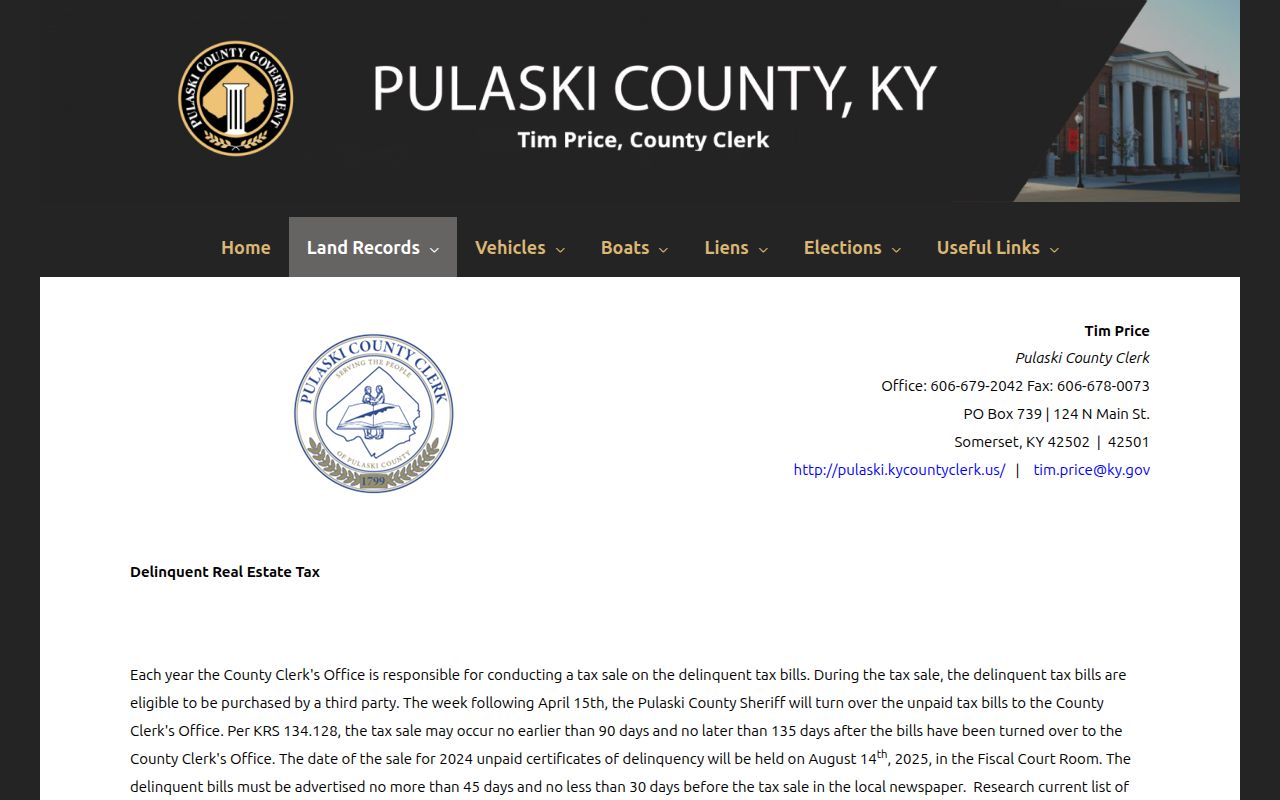
Payments for delinquent tax bills are handled separately from ordinary copy fees. The Clerk accepts a cashier's or certified check, a money order, a credit card with a $4 convenience fee, or cash. Personal, business, and over-the-counter checks are excluded.
Pulaski County Court Property Records
The Pulaski County Court of Justice handles Circuit, Family, District, and Business cases. CourtNet supports searches by party or business name, case number, and citation. A docket can lead somewhere useful for a property search. It might surface a foreclosure judgment, a commissioner deed, a partition, a quiet-title ruling, a probate file, or lien enforcement. Still, a court result alone never updates the county deed chain.
To tie a case to the parcel, match it through the address, legal description, map ID, mortgage, lis pendens, judgment, or recorded instrument references. A shared name is weak proof on its own. The Circuit Court Clerk is the legal custodian of local court records. The office sits at 50 Public Square. Archived requests need a case or file locator, because the state facility will not run a name-only search.
Pulaski County City Property Records
Somerset, Ferguson, and Burnside do not replace Pulaski County deed or assessment systems. They add municipal layers on top. Somerset publishes zoning, subdivision, engineering, and ordinance files. Ferguson provides a city boundary map, a zoning-permit route, ordinances, and a public-record request path. Burnside offers municipal permit and license downloads plus a clerk request route.
City geography can be subtle, though. A ZIP code or mailing city is not the same as a corporate limit. Somerset Ordinance 19-23 names Mayfair, Creekside, Eagles Nest, KY 39, Talon Way, and Broyles Road. It also expressly warns that its annexation line is not an individual parcel line. That distinction matters in Pulaski County property records. It keeps municipal status from being mistaken for a deeded boundary.
Pulaski County Deed Record Copies
Online access is only one route to Pulaski County property records. The Clerk directs land-record work to 100 North Main Street. Hours run Monday through Friday from 8:00 a.m. to 4:30 p.m. Regular copies run $0.50 per page. Certified copies cost $5 for the first three pages and $0.50 for each additional page. Mailed requests add $2 for postage and handling. Before paying the premium, pause and ask. Does the receiving court, estate, lender, or agency truly require certification?
The official copy instructions are the best place to verify current charges. A Kentucky Open Records Act request under KRS 61.870 through 61.884 can reach a specific public file. This works outside the ordinary portal. Give the custodian an address, the full map ID, names, a date range, a deed or plat citation, the record type. State the delivery form you want.
The Clerk's land-record page is the public route into recorded Pulaski County property records. It covers deeds and plats.
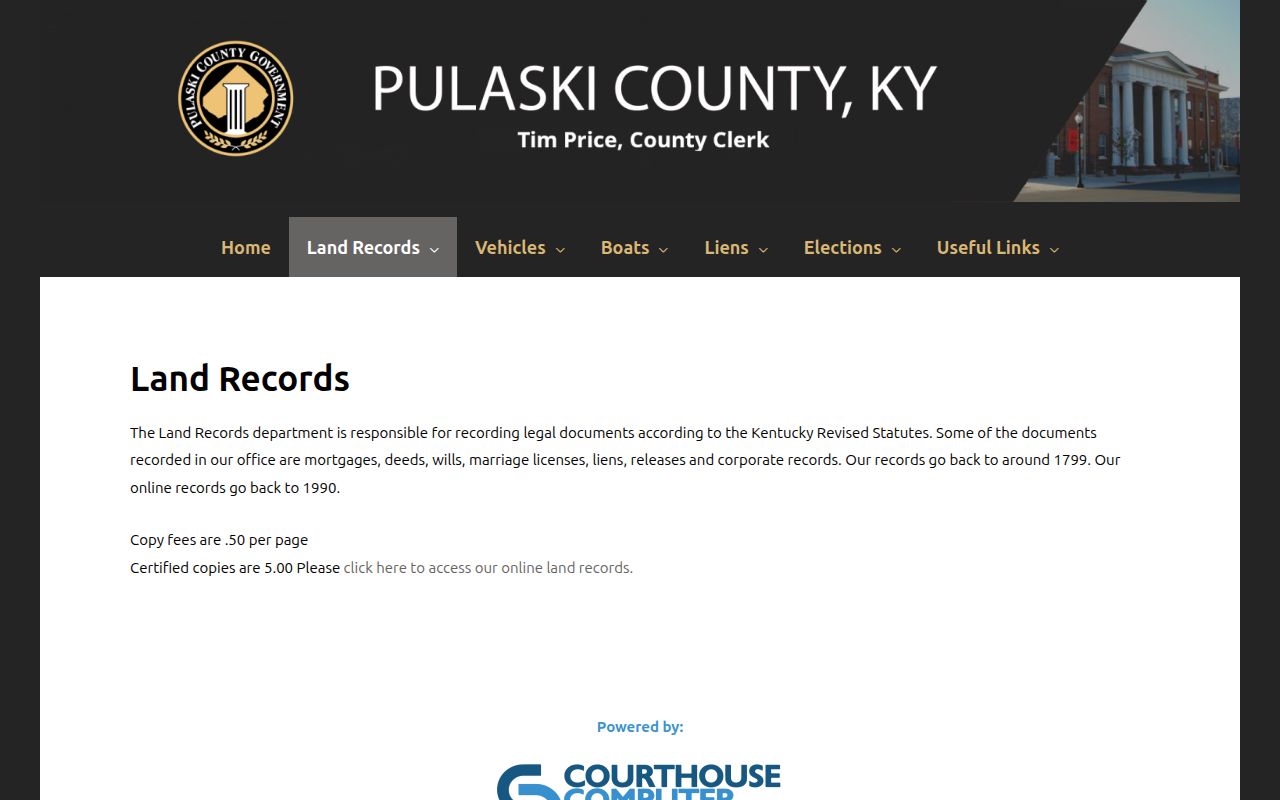
The public page confirms the record families and the historical depth of the deed records, even without logging into the commercial system behind the link.
Pulaski County Property Fraud Alerts
The Pulaski County Clerk offers a name-match fraud notification service. A user selects names. The system checks newly recorded documents each day. An email goes out when a matching name appears. That can help an owner, heir, or family member learn of a filing soon after it enters the Clerk's system. It is especially useful when land is held under more than one name form.
An alert is only a prompt to inspect the instrument. Common names produce unrelated matches, and a message alone does not establish fraud. Retrieve the document. Compare the grantor, grantee, legal description, parcel clues, and recording references. Then contact the Clerk about an indexing concern. Title advice or a disputed conveyance may call for a Kentucky attorney. The alert neither blocks a document nor clears title.
Careful name planning pays off here. Include known personal forms and the exact deeded entity name. Do not add an officer's name as though that person owns corporate land. Recheck your selected names after a marriage, an estate transfer, a trust change, or a recorded correction to the deed records.
Pulaski County Assessment Record Appeals
Kentucky law pushes the PVA to review each Pulaski County property at least once every four years, and new construction goes on the roll annually. Any area can be re-examined sooner. An owner who contests the assessed value starts with a conference at the PVA office. Strong evidence helps. Bring accurate property characteristics, dated photographs, and repair facts. Comparable qualified sales should match the location, property type, acreage, and age of the parcel. For 2026, the roll stayed open for inspection from June 1 through June 15, with appeals due June 16. Those dates shift each year. Confirm them against the current notice. After the conference, Pulaski procedure calls for one signed form per property, delivered to the County Clerk in Room 208 at 100 Main Street, attention Samantha Owens. A representative must carry written owner authorization. Any contingency arrangement also needs disclosure, unless the representative is a lawyer.
An appeal tests the PVA's value. It does not judge a deed's validity. A title dispute, boundary conflict, or wrong legal description belongs in a different process. Keep the question narrow. That helps the office route it and keeps tax evidence from being confused with ownership evidence. The same discipline applies to copies and portal printouts. Keep the page header, tax year, retrieval date, and full parcel number with each item, because annual rolls, delinquent lists, and appeal notices change. Recheck the newest deed before any sale, estate filing, or boundary decision.
Limits of Pulaski Property Records
Pulaski County property records can answer a lot. They show the recorded owner, the legal description, the assessed value, recorded mortgages and liens, tax status, and some court or city history. No record guarantees that an unrecorded interest is absent. A GIS display is not a survey. An assessment is not a sale appraisal, nor is an annexation map a parcel plat or a delinquent-tax list a completed transfer.
Lawful use. Use Pulaski County property records for lawful due diligence, boundaries, tax review, history, estates, and civic work. Never use owner data to stalk, harass, or harm a person.
Specialists fill these gaps. A licensed Kentucky surveyor fixes the line. An attorney or title company can examine the full chain and its exceptions for a transaction, and when a portal summary and a source document differ, the official custodian's copy is the right evidence.