
Pulaski County Deed Types
Kentucky law assigns deed recording to the County Clerk. KRS Chapter 382 frames the process. In Pulaski County, the Clerk maintains the books, the index, and the recorded copies. Read a deed for three things. Who gave up an interest, who took it, and what land the instrument described. The deed type and its wording shape how much interest actually passed. The Clerk's collections reach well past deeds, too. Mortgages, wills, liens, releases, marriage records, and corporate filings all appear. An index search surfaces far more than simple conveyances.
| Deed Type | What It Does | Common Use |
|---|---|---|
| General warranty deed | Conveys the stated land with broad title covenants | Many ordinary sales |
| Quitclaim deed | Conveys whatever interest the grantor may hold | Family or title-cleanup transfers |
| Special warranty deed | Uses covenants limited by the deed's terms | Transactions needing narrower assurances |
| Executor or fiduciary deed | Conveys under documented estate authority | Probate and estate administration |
| Commissioner or tax deed | Records a transfer following a legal sale process | Judicial or delinquent-tax matters |
Not every recorded instrument transfers land. A mortgage or lien burdens property instead of selling it, and a release later discharges that claim. Check the document type, the parties, the date, the legal description, and any cross-reference. A name match alone never proves a sale happened.
Pulaski County Deeds Since 1799
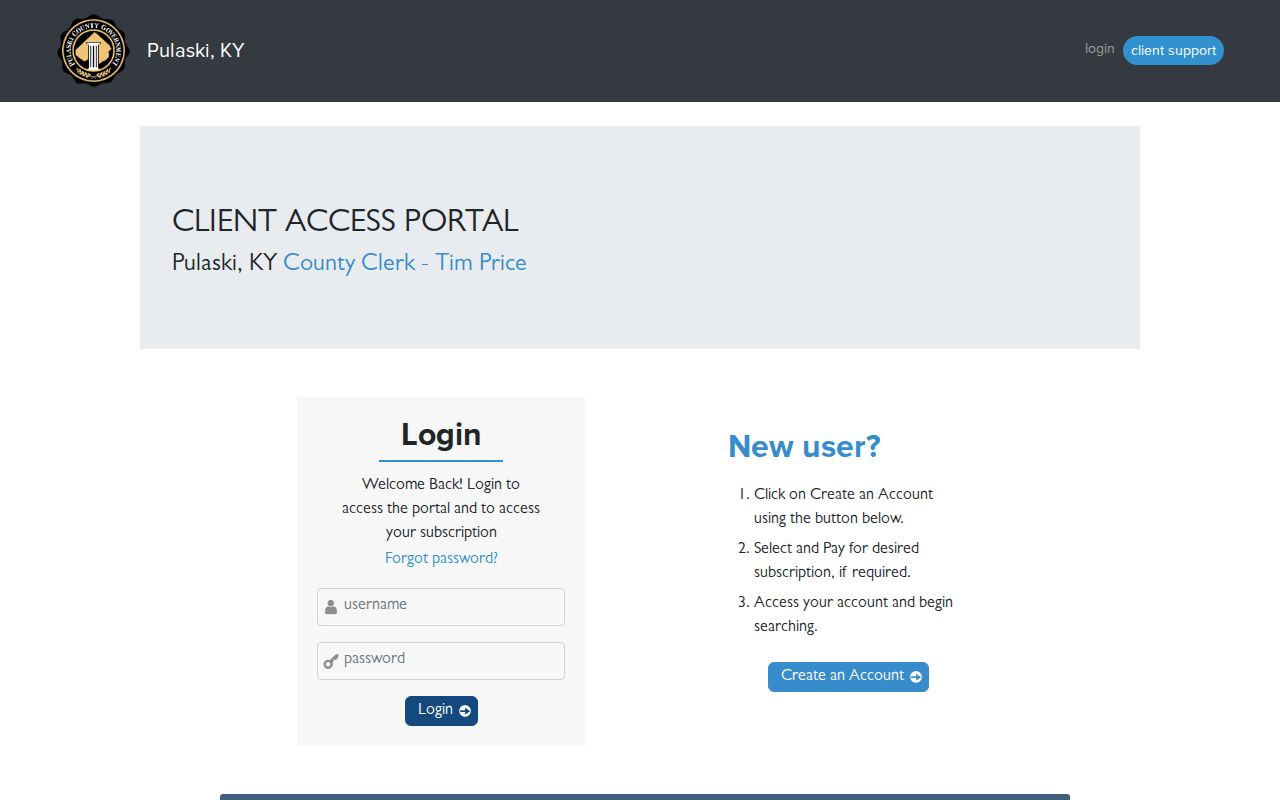
The Pulaski County Clerk land-record page traces the county's deed holdings back to roughly 1799. Online coverage starts around 1990. That leaves a clear split in how you search. Newer Pulaski County deed records open through the linked Courthouse Computer Systems login. Anything older means the Clerk's physical books, plats, or archival storage.
The login leads to newer records only. Its search filters, result columns, and image availability vary. Do not assume a date or instrument-type screen exists. A failed search there proves nothing about whether an instrument was recorded. For material before the online era, call 606-679-2042 or visit the office at 100 North Main Street.
The Clerk's public land-record entry point displays the gateway into the deed system and its login link.
Treat the online login as a convenience for recent filings. The books still hold the older Pulaski chain of title.
Follow Pulaski County Deed Links
Grantor and grantee roles give Pulaski County deed records their connective power. Start with a deed you already trust. The current owner appears as grantee, and the prior owner as grantor. Then search that prior owner as grantee to reach the earlier purchase. Keep going only when the legal description, map ID, subdivision, acreage, and cited plat all match, because those details confirm you are still following the same parcel.
- Find the present owner's acquisition deed and verify the parcel description.
- Record its grantor, grantee, date, deed type, and book/page or other citation.
- Search the grantor as an earlier grantee and compare the land description again.
- Follow cross-referenced deeds, plats, releases, probate cases, or commissioner sales.
- Move to physical books when the chain reaches the approximately 1990 online cutoff.
- Grantor
- The party that conveys the stated interest.
- Grantee
- The party that receives the stated interest.
- Chain of title
- The linked sequence of recorded conveyances for the same land.
- Book and page
- A citation used to retrieve a recorded instrument from a volume.
Pulaski County Deed Plat Citations
Named plats work as strong bridge keys in Pulaski County. A Fiscal Court packet cites Brunson Subdivision and Additions of Burnside at Plat Book 1, page 40. It also points to Deed Book 207, page 12 from 1956. And it lists Deed Book 685, page 159 from 2001. A modern address search may skip that older subdivision wording. Yet the book and page lead straight back to the Clerk's holdings.
Somerset's Valley Oak annexation file offers a second example. It cites Deed Book 1068, page 254 and Plat Cabinet G slides 236B and 236C. The file also carries two tract-acreage figures. Ordinance 19-23 names Mayfair, Creekside, and Eagles Nest. It also lists KY 39, Talon Way, and Broyles Road. Municipal sources help locate deed records, but an annexation survey line is not an individual parcel boundary.
Note: Keep the exact spelling, book and page, cabinet slide, road name, and acreage when asking the Clerk to pull a deed.
Pulaski County Deeds and Liens
A thorough deed search reaches instruments that affect land without conveying it. The Clerk lists mortgages, liens, and releases among its recorded collections. Search both sides of any transaction. Watch for later releases, corrections, assignments, or court references. An old mortgage hit does not mean the debt survives. A recorded release or court order may have settled it long ago.
Foreclosure adds its own layer. CourtNet can show the case history, judgment, order of sale, or report of sale. Match the resulting commissioner deed back to Pulaski County deed records. This keeps the chain intact. A delinquent-tax list proves even less. It reports a bill, owner string, map ID, amount, and status at a report date. That is not a completed transfer of title.
Pulaski County Deed Fraud Alerts
The Clerk offers a fraud-detection service that checks newly recorded documents against names you select. When a filing matches, the service sends an email alert. Property owners and families watching estate land find it a practical early warning.
Know what the alert cannot do. It does not validate a document. It does not fix the index, block a filing, or offer a title opinion. Treat a match as a prompt. Return to the Clerk for the instrument image or an official copy. Compare its legal description and parties against the known parcel. Do this before concluding it touches the same land.
Older Pulaski County Deed Sources
When a Pulaski County deed chain runs older than the online index, start with the Clerk and widen outward. The Kentucky State Land Office holds warrants and patents, the records of the state's earliest land dispositions. A patent marks the first grant. Everything after it is county business. Deeds, tax lists, plats, partitions, marriages, probate, and mortgages explain what happened to the land next.
KDLA guides decode old book structure. The deed-record handout helps with historic indexing. The Pulaski County Public Library holds newspapers, directories, plats, obituaries, and genealogy material, though exact year runs vary, so ask staff what survives rather than assuming a specific city directory exists.
Pulaski County Deed Descriptions
A street address only locates property. It is not the deeded land description. Pulaski County deeds instead describe a lot and block, a recorded plat, an acreage tract, adjoining owners, a road right-of-way, or courses and distances. Carry the exact wording from one conveyance to the next, because a small mismatch can point to a parent tract, a later split, an easement, or different land held by the same party.
City files can bridge gaps in wording. Somerset annexation surveys cite roads, developments, deeds, plats, and acreage. Ferguson's railroad history preserves older terms like Ferguson Shops and Murphy Avenue, while Burnside's Brunson reference leads to a specific plat and deed books. None of that replaces the Clerk's recorded description. It just helps you find it.
When two descriptions differ, resist the web map. A traced line settles nothing. Pull each cited plat and deed, then check whether a correction, release, subdivision, annexation, probate event, or commissioner conveyance intervened between them. A Kentucky-licensed surveyor gives the on-the-ground boundary opinion.
Pulaski County Estate Deeds
Wills sit right in the Clerk's land-record collection. A Pulaski estate trail can also run through Circuit Court probate files. Start from the current PVA name and map ID. Then hunt for the deed, will, executor or fiduciary deed, probate case, settlement, or partition. A death certificate proves a death. It does not convey land.
The PVA requires the official deed or will to be recorded with the right office before a property-record or tax-bill name changes, or a death certificate supplied to the PVA where appropriate. That policy shows the line between creating legal authority and maintaining the assessment roll. A PVA correction never substitutes for a missing conveyance.
Suppose no recorded will or deed appears. A probate file may still name devisees, an executor, fiduciary authority, or property schedules. Match each court clue to the legal description. Then return to Pulaski County deed records for any later executor, commissioner, partition, or beneficiary conveyance.
Order a Pulaski County Deed
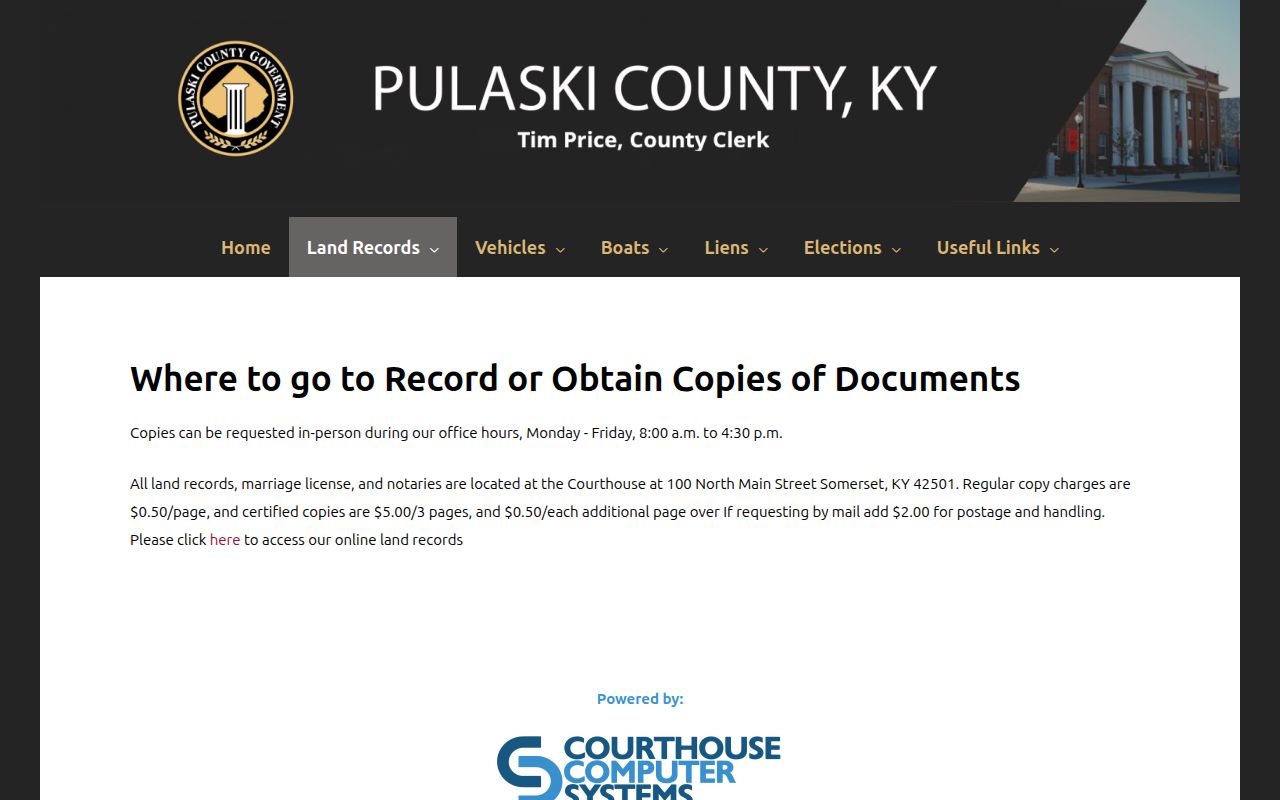
The Clerk takes in-person deed-copy requests at 100 North Main Street in Somerset. Office hours run Monday through Friday, 8:00 a.m. to 4:30 p.m. Regular copies run $0.50 per page. The detailed certified-copy rule is $5 for the first three pages and $0.50 for each additional page. Mailed requests add $2 for postage and handling.
Consult the official copy procedure before sending payment. Fees change. Give the Clerk the names, approximate recording date, deed type, current and former address, full map ID, subdivision or plat, and any known book/page. Say whether a plain or certified copy is needed.
Certification changes the price, not the parcel. A certified copy proves the deed is genuine, but it cannot fix a parcel mismatch or make the instrument newer.
Recorded, not guaranteed. Pulaski County deed records show filed instruments, not every possible unrecorded interest. A lawyer or title professional must evaluate the chain for a transaction.